Monday, February 11, 2019

Celebrating Moliere

“The more we love our friends, the less we flatter them;
It is by excusing nothing that pure love shows itself.”
—Molière 
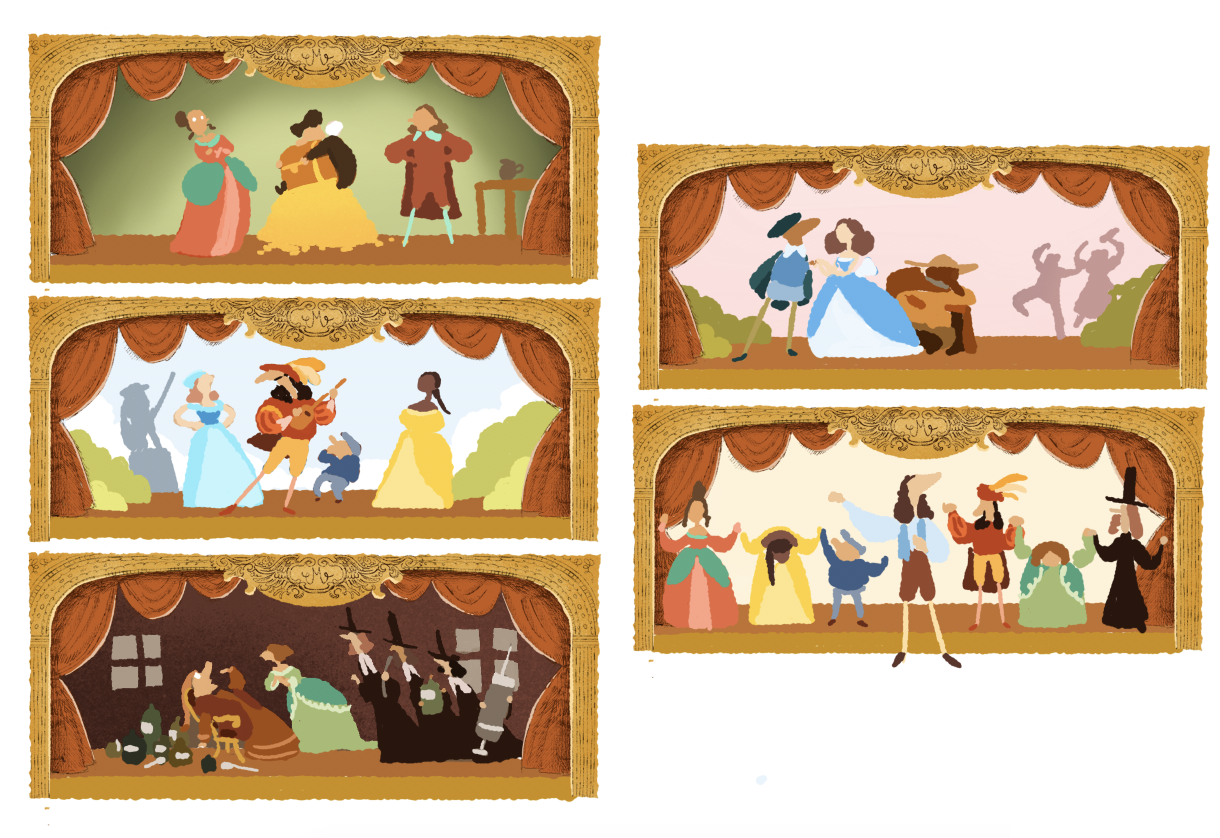
Today’s Doodle celebrates the life and work of actor and playwright Molière, who is widely considered the world’s foremost comic dramatist and perhaps the greatest artist in the history of French theater. His satirical plays fearlessly lampooned human folly and blended ballet, music, and comedy into a new genre that transformed buffoonery into witty social critique. 
On this day in 1673, Molière premiered his final play, Le Malade Imaginaire (The Imaginary Invalid), a three-act comédie-ballet satirizing the medical profession. Molière starred in the title role of Argan, a severe hypochondriac who tries to convince his daughter to forsake her true love and marry his doctor’s son, so as to save on medical bills. In classic Molière fashion, the play’s dialogue pushes his characters’ vices and pretensions to the point of absurdity. Today’s Doodle provides a glimpse into Molière’s most memorable scenes from The Imaginary Invalid and other classics like School for Wives, Don Juan, and The Miser.
Baptized in Paris in 1622 as Jean-Baptiste Poquelin, Molière was the son of a successful furniture maker and upholsterer to the royal court. Rejecting his father’s offer to take up the family trade, he assumed the stage name Molière and began a lifetime in the theater during the 1640s. Enduring years of financial hardship, Molière was imprisoned for debts before his breakthrough in 1658, when his company performed for a royal audience at the Louvre. 
Despite royal support, Molière’s unsparing pen offended powerful interests who sought to censor his work. His religious satire Tartuffe was first performed in 1664 and immediately banned by the court of King Louis XIV. Five years later the ban was lifted and Tartuffecame to be considered one of his masterworks.
Inspiring future generations of comedians, Molière’s spirit lives on today through the work of humorists and satirists who share a fearless commitment to skewering hypocrisy with sharp-edged insights. As Molière wrote in the preface to Tartuffe, “The duty of comedy is to correct men by amusing them.”
10.02.2019-Sunday-ஞாயிறு-Doodle by Helene Leroux-Celebrating Moliere-PNG
10.02.2019-Sunday-ஞாயிறு-Early Draft of Doodle by Helene Leroux-Celebrating Moliere-PNG
10.02.2019-Sunday-ஞாயிறு-Earlier Drafts of Doodle by Helene Leroux-Celebrating Moliere-PNG
10.02.2019-Sunday-ஞாயிறு-Doodle by Helene Leroux-Celebrating Moliere-PNG

65th Anniversary of the Quebec Winter Carnival

What better way to liven up Canada’s coldest season than to host a big celebration amidst the snowfall and subzero temperatures? The tradition of winter festivals dates back to the 17th-century colonies known as New France, but the first organized carnivals in modern times occurred 125 years ago in Québec City, setting the blueprint for more than a century of frosty fun.
The Québec Winter Carnival, which became an annual tradition starting in 1954, is also the oldest of the festivals held across Canada to relieve the routine of short days and chilly nights. Frank Carrel, proprietor and managing editor of the Quebec Daily Telegraph, devised the Carnival as a way to raise spirits during the winter season. Erecting an ice palace in front of the Parliament building, the Carnaval de Québec also featured a parade, concerts, sporting competitions, and a number of other activities across the city.
Now attended by more than  half a million people each year, the carnival has its own official representative named Bonhomme, a large snowman who always wears a red cap, black buttons, and a ceinture fléchée, or “arrowed sash.” He lords over his own ice palace and leads a night parade along Grande Allée, which is decorated with lights and ice sculptures.
Over the years the carnival soundtrack has evolved from polkas and waltzes to rock and dance music. Today, the 65th anniversary of the Québec Winter Carnival kicks off and children throughout the city can be seen enjoying the snowy celebrations while paying homage to their favourite snowman —a scene depicted in today’s Doodle by Canadian-born, New-York-based guest artist Randeep Katari. Other festivities include the annual ice canoe race on the St. Lawrence River, axe throwing, and—for the truly intrepid—the Snow Bath, a rare convergence of snowdrifts and swimming trunks.
Joyeux Carnaval!

A message from the creator of today’s Doodle, Randeep Katari:

 
I found out I was going to be doing the Doodle for the Québec Winter Carnival just before the winter holidays. Luckily, I was planning on visiting Vancouver and Toronto so I decided to try something a little different and unconventional. I bought some moulds, and froze the letters for Google in real ice:
08.02.2019-Friday-வெள்ளி-Doodle-65th Anniversary of the Quebec Winter Carnival-JPEG

Then, I edited the image digitally to remove the background and add some characters to colour the scene.
08.02.2019-Friday-வெள்ளி-Doodle-65th Anniversary of the Quebec Winter Carnival-JPEG

I spent some time designing the characters before adding them to the final scene. Finally, I coloured the ceinture fléchée (sash), added highlights, and did some colour correction and alteration with the help of Doodler Alyssa Winans.
08.02.2019-Friday-வெள்ளி-Doodle-65th Anniversary of the Quebec Winter Carnival-JPEG


Friedlieb Ferdinand Runge’s 225th Birthday

Today’s Doodle celebrates Friedlieb Ferdinand Runge, a German analytical chemist whose place in history resulted in large part from an accident followed by a chance encounter. 
Runge was born outside of Hamburg on this day in 1795. The son of a Lutheran pastor, he expressed interest in chemistry from an early age and began conducting experiments as a teenager.
During one such experiment, Runge accidentally splashed a drop of belladonna extract in his eye, taking note of its pupil-dilating effects. Ten years later, while studying under renowned chemist and inventor Johann Wolfgang Döbereiner at the University of Jena, Runge was asked to reproduce belladonna’s effects as part of a demonstration for one of Döbereiner’s friends: the writer and polymath Johann Wolfgang von Goethe. Impressed by the 25-year-old chemist, Goethe handed Runge a bag of rare coffee beans and suggested he analyze their chemical makeup. Shortly thereafter, Runge isolated the active ingredient we know today as caffeine!
After earning his doctorate from the University of Berlin, Runge went on to teach at the University of Breslau until 1831 when he left academia to take a position at a chemical company. During this time, he invented the first coal tar dye and a related process for dyeing clothes. His contributions to the world also include: being one of the first scientists to isolate quinine (a drug used to treat malaria), being considered an originator of paper chromatography (an early technique for separating chemical substances), and even devising a method for extracting sugar from beet juice.
Here’s to Runge, without whom the pain of forgoing one’s morning cup of coffee might never have had a scientific explanation!
08.02.2019-Friday-வெள்ளி-Doodle-Friedlieb Ferdinand Runge’s 225th Birthday-PNG
08.02.2019-Friday-வெள்ளி-Doodle-Friedlieb Ferdinand Runge’s 225th Birthday-GIF
08.02.2019-Friday-வெள்ளி-Doodle-Friedlieb Ferdinand Runge’s 225th Birthday-GIF

Waitangi Day 2019

Waitangi Day is the national day of New Zealand, commemorating the signing of the Treaty of Waitangi in 1840. In honour of Waitangi Day, today’s Doodle celebrates the unique native flora of the island nation.

Geographically isolated in the South Pacific Ocean, New Zealand has evolved a diverse variety of plant life. Some 80 percent of the islands’ fern, flower, and tree species are native to the country and, most can be found nowhere else in the world.

The silver fern has long been a symbol of New Zealand’s identity, appearing on the uniforms of national sports teams as well as military troops. To Māori, it has been a symbol of strength and resilience.. Known to grow up to 10 meters in height, the underside of the silver fern’s leaves reflects moonlight, making it helpful when following forest trails at night.

New Zealand’s unofficial national flower, the bright yellow blossoms of the Kōwhai tree, appear near the end of winter. The tree’s bark is renowned for its medicinal properties, useful for treating everything from dandruff to seal bites.

The Pōhutukawa’s crimson flowers bloom around the holiday season, leading to the name “New Zealand Christmas Tree.” The plant also figures prominently in Māori legends as a bridge between the living and the spirit world. Aside from decorating homes and churches, the Pōhutukawa’s nectar can be used to make delicious honey and treat sore throats.

Happy Waitangi Day 2019!​
06.02.2019-Wednesday-புதன்-Doodle-Waitangi Day 2019-JPEG

Tuesday, February 5, 2019

Lunar New Year (Vietnam) 2019

Today is the first day of the first month of the lunar calendar, a major holiday celebrated throughout most of Asia. Also referred to as the Spring Festival or Chinese New Year, this holiday celebrates ancient traditions and ancestors as well as good times ahead. Different nations will mark the transition from the Year of the Dog to the Year of the Pig in their own unique way.

This year celebrates the Pig, the last animal in the cycle of 12 that represent each year in the shēngxiào, or Chinese zodiac. Pigs are considered a sign of prosperity in Asian culture, and those born in the year of the Pig are said to be sincere, good-natured, and honest.

Today’s Doodle also celebrates the ancient tradition of shadow puppetry, which also has a special place in the festivities. This year, people all over the world can Celebrate Lunar New Year and the ancient storytelling art of shadow puppetry with Shadow Art. Users can form one of the twelve zodiac animal hand gestures in front of their camera and the AI system, built with Tensorflow, will play a short clip matching the shadow puppet that’s been made.

Preparations for the Lunar New Year begin well in advance of the new moon as families clean and decorate their homes, sweeping out last year’s bad luck. All cleaning stops as soon as the new year begins, for fear of driving the good luck out. Many purchase new clothes and shoes so as to make a fresh start.

The color red can be seen everywhere. A symbol of good luck, red is believed to ward off bad luck and beasts. Families come together to share special meals and exchange gifts. Children often receive “lucky money,” usually in red envelopes given by their elders.

In Vietnam, the holiday is named Tết Nguyên Đán, or Tết for short. It is a time to gather with relatives and loved ones, and enjoy traditional delicacies like banh chung, a square-shaped sticky rice cake filled with mung beans and pork and wrapped in banana leaves. Not only enjoyed by the living, banh chung is also placed on household altars paying tribute to each family’s ancestors. Households also welcome visits from people outside the family. The first visitor in the new year is said to determine the family’s fortune for that year.

Happy Lunar New Year! ​
05.02.2019-Tuesday-செவ்வாய்-Doodle-Lunar New Year (Vietnam) 2019-GIF

Lunar New Year (South Korea) 2019

Today is the first day of the first month of the lunar calendar, a major holiday celebrated throughout most of Asia. Also referred to as the Spring Festival or Chinese New Year, this holiday celebrates ancient traditions and ancestors as well as good times ahead.

This year marks the transition from the Year of the Dog to the Year of the Pig, the last animal in the cycle of 12 that represent each year in the shēngxiào, or Chinese zodiac. Pigs are considered a sign of prosperity in Asian culture, and those born in the year of the Pig are said to be sincere, good-natured, and honest.

Today’s Doodle also celebrates the ancient tradition of shadow puppetry, which also has a special place in the festivities. This year, people all over the world can Celebrate Lunar New Year and the ancient storytelling art of shadow puppetry with Shadow Art. Users can form one of the twelve zodiac animal hand gestures in front of their camera and the AI system, built with Tensorflow, will play a short clip matching the shadow puppet that’s been made.

In South Korea, the holiday is also known as soll. Traditional commemorations include visits to pay respect to family members and a meal of dduk gook or rice cake soup. New Year’s wishes are sometimes written on kites and then flown in the sky.

Happy Lunar New Year!
05.02.2019-Tuesday-செவ்வாய்-Doodle-Lunar New Year (South Korea) 2019-GIF

Lunar New Year (Multiple Countries) 2019

Today is the first day of the first month of the lunar calendar, a major holiday celebrated throughout most of Asia and around the world. Also referred to as the Spring Festival or Chinese New Year, this holiday celebrates ancient traditions and ancestors and looks forward at the year ahead.

This year marks the transition from the Year of the Dog to that of the Pig, the last animal in the cycle of 12 that represent each year in the shēngxiào, or Chinese zodiac. Pigs are considered a sign of prosperity in Asian culture, and those born in the year of the Pig are said to be sincere, good-natured, and honest.

Today’s Doodle also celebrates the ancient tradition of shadow puppetry, which also has a special place in the festivities. This year, people all over the world can Celebrate Lunar New Year and the ancient storytelling art of shadow puppetry with Shadow Art. Users can form one of the twelve zodiac animal hand gestures in front of their camera and the AI system, built with Tensorflow, will play a short clip matching the shadow puppet that’s been made.

Preparations for the Lunar New Year begin well in advance of the new moon as families clean and decorate their homes, sweeping out last year’s bad luck. All cleaning stops as soon as the new year begins, for fear of driving the good luck out. Many purchase new clothes and shoes so as to make a fresh start.

The color red can be seen everywhere. A symbol of good luck, red is believed to ward off bad luck and beasts. Families come together to share special meals and exchange gifts. Children often receive “lucky money,” usually in red envelopes given by their elders.

Throughout  China, the holiday season—also known as chunjie (春节)—lasts for more than two weeks and celebrations vary throughout the region. Plenty of fireworks are also set off during this time of year as tradition states the loud noise scares  monsters and bad luck away. In Hong Kong, the celebration combines ancient customs, and modern excitement. A night parade kicks off the festivities with floats, dragons, dancers, and musicians. In Taiwan, the focus is on family and friends rather than big public events. Many Taiwanese enjoy visiting temples and other historic sites as well as spending time with relatives.

Happy Lunar New Year!
05.02.2019-Tuesday-செவ்வாய்-Doodle-Lunar New Year (Multiple Countries) 2019-GIF